Products
+


Version: Industry Research White Paper Date: June 2026
Authoring Organization: Tianxian Digital Intelligence & Magizheng Intelligence Industry Research Team Abstract
Driven by the dual forces of the global energy structure transformation and the Industrial 4.0 wave, the new energy equipment industry is shifting from "scale expansion" to "efficiency competition" and "precision revolution". The absolute value magnetic scale encoder, with its core advantages such as power-off memory, anti-pollution, long stroke, and high reliability, is upgrading from the "perception end" of the automation system to the "decision node" in the era of intelligent manufacturing.
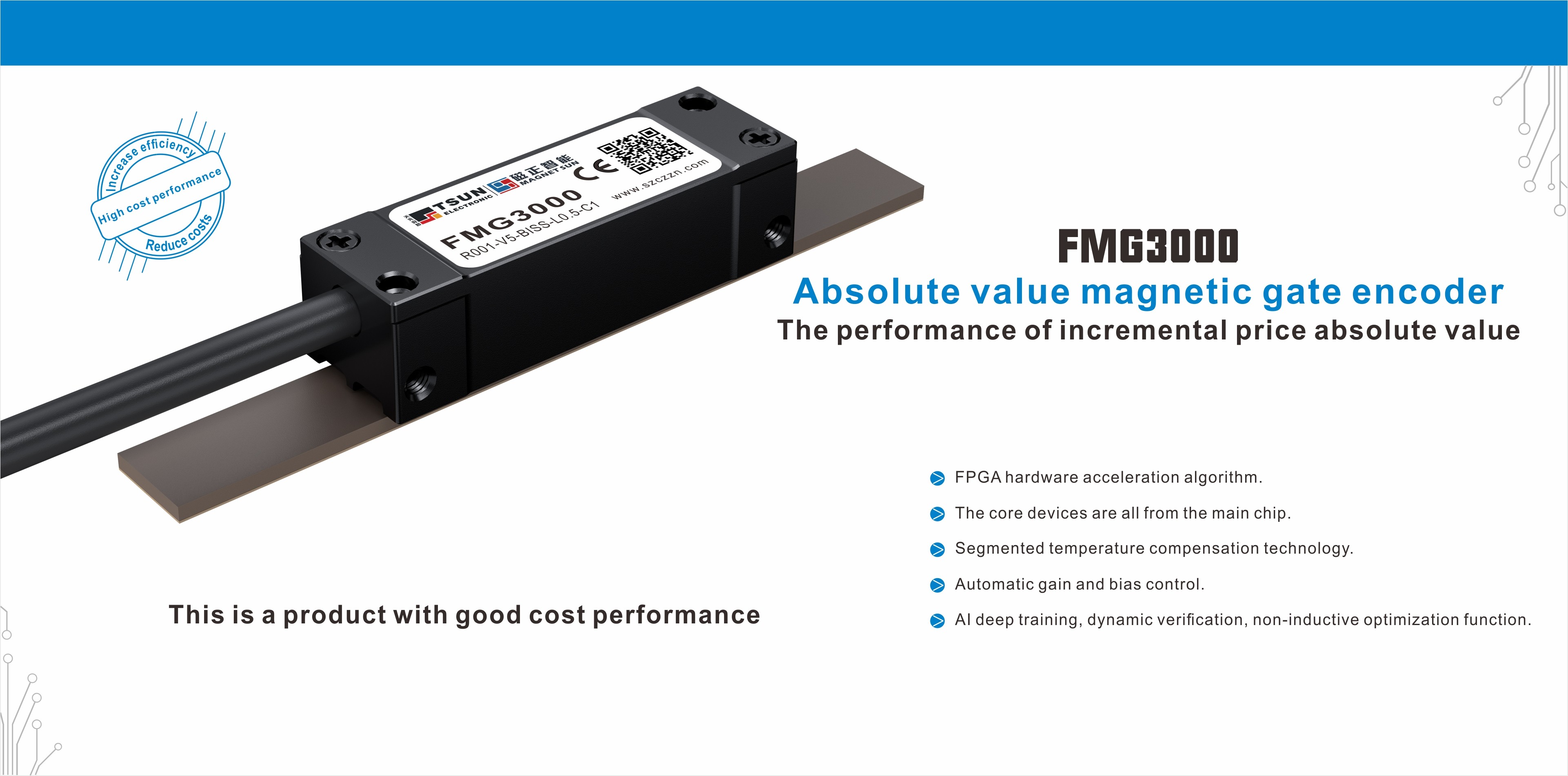
This white paper is based on the latest data of the global magnetic encoder market, deeply analyzing the technical penetration path of absolute value magnetic grating encoders in the new energy sectors such as lithium batteries, photovoltaics, wind power, and new energy vehicles. It also combines the technical parameters and industry application cases of products like FMG3000 under the brands of Tianxian Digital Intelligence and Magnetic Positive Intelligence, systematically elaborating on the industrial opportunities and competitive landscape of magnetic sensing technology in the new energy era in China.
Chapter 1: Industry Background: The "Precision" Turning Point of New Energy Equipment
1.1 Structural Upgrading of the New Energy Industry
The global new energy industry is undergoing a paradigm shift from "scale expansion" to "efficiency competition". The requirements for the coating accuracy of electrode sheets in lithium battery manufacturing have advanced from micrometer level to sub-micrometer level, the main shaft synchronization accuracy of photovoltaic silicon wafer slicing directly determines the yield rate, the angle feedback error tolerance of wind turbine pitch systems has been compressed to the angular level, and the assembly accuracy of the three-electric system of new energy vehicles directly affects the performance and safety of the entire vehicle.
Against this backdrop, automation equipment has put forward requirements for the precision, stability, and environmental adaptability of position and speed measurement far beyond those of traditional industries. Encoders - as the "sensory system" of motion control systems - their performance boundaries directly determine the upper limit of equipment precision and the lower limit of reliability.
1.2 Comparison of Encoder Technology Routes: Magnetic vs. Optical
Currently, the high-precision displacement measurement field mainly has two technical routes:
Optical encoders: The upper limit of precision is higher (up to nanometer level), but they have a natural drawback - they are extremely sensitive to dust, oil stains, water vapor, and vibration, have poor environmental adaptability, and have strict installation accuracy requirements. In the harsh working conditions of new energy production lines (such as electrolyte evaporation in the lithium battery workshop, cutting debris liquid and dust in the photovoltaic slicing workshop, and lubricant contamination in the wind turbine gearbox), the reliability of optical encoders faces severe challenges.
Magnetic encoders: Based on the magnetoresistance effect (AMR/GMR/TMR) or Hall effect for non-contact measurement, they naturally have environmental advantages such as anti-pollution, anti-vibration, anti-humidity, and wide temperature range. In recent years, with breakthroughs in magnetic material processing and signal processing algorithms, the resolution and precision of magnetic encoders have continuously improved, gradually penetrating from "environmental adaptability priority" scenarios to high-precision fields.
Industry research institutions' data confirm this trend: The market is undergoing a 42% technological migration from optics to magnetism, and the penetration rate of magnetic encoders in high-reliability scenarios is continuously increasing.
1.3 Strategic Value of Absolute Value Encoders
In the classification of encoders, absolute value encoders have essential advantages over incremental encoders: They can retain the absolute position after power failure and do not require re-zeroing after power-on. This characteristic is of great significance for new energy equipment - the lithium battery production line operates 7×24 hours continuously, any re-calibration after shutdown will cause production losses; the wind turbine pitch system's rapid recovery ability after grid fluctuations directly relates to safety.
According to a report by strategic management consulting firm Lucintel, the market is undergoing a 42% technological migration from optics to magnetism, and the penetration rate of absolute value magnetic encoders in high-reliability scenarios is continuously increasing. According to Global Info Research data, the global revenue of magnetic absolute encoders is approximately 630 million US dollars in 2024, and is expected to reach 1.034 billion US dollars in 2031, with a compound annual growth rate (CAGR) of 7.4%.
Chapter 2: In-depth Technical Analysis: The Core Competitiveness of FMG3000
2.1 Technical Architecture and Core Parameters
The FMG3000 series of absolute value magnetic grating encoders under the brands of Tianxian Digital Intelligence and Magnetic Positive Intelligence represent the industrial breakthrough of domestic magnetic sensing technology. Their core technical indicators are as follows:
Parameter Item Parameters of FMG3000 Industry Significance
Measurement Resolution 0.1-1μm Meet the precision requirements of sub-micrometer level Maximum operating speed: 5m/s. Suitable for high-speed automated production line cycle.
Repeatability accuracy:<2μm. Ensures consistency in batch production.
System accuracy: ±20μm/m. Core guarantee for long-stroke applications.
Position delay:<62.5μs. Millisecond-level real-time response.
Operating temperature: -10℃ ~ +70℃. Wide temperature range adaptability.
Protection level: IP67. Completely dust-proof and water-resistant.
Anti-vibration: 300m/s² (55-2000Hz). Reliability in extreme conditions.
In terms of communication interfaces, the FMG3000 supports various industrial protocols such as BISS-C, SSI, RS-485, PANASONIC, and Morisawa, with a maximum clock frequency of 2.5MHz and a data bit depth of 26 bits. This multi-protocol compatibility design significantly reduces the system integration threshold and enables rapid adaptation to different brands of controllers and drivers.
2.2 Five core technological innovations
1. FPGA hardware acceleration algorithm
The signal processing of traditional encoders relies on MCU software operations, which have processing delays and jitter. The FMG3000 adopts a FPGA hardware parallel processing architecture, implementing core algorithms such as signal decoding, filtering, and interpolation at the hardware level. The position delay is controlled within 62.5μs, meeting the strict requirements for real-time performance in high-speed motion control scenarios.
2. Autonomous wafer fabrication of core components
In the context of increasingly important supply chain security, the core sensing chip of the FMG3000 is designed and fabricated independently, ensuring performance consistency and supply stability from the source. This is a strategic value point that cannot be ignored for new energy equipment enterprises that pursue autonomous control of the supply chain.
3. Segmented temperature compensation technology
The temperature coefficient of magnetic materials is a key factor affecting the accuracy of magnetic encoders. The FMG3000 incorporates multiple-point temperature sensors and combines segmented compensation algorithms to automatically correct accuracy within the working temperature range of -10℃ to +70℃, effectively suppressing temperature drift errors. This feature is particularly important in wind power and outdoor energy storage scenarios with significant temperature variations.
4. Automatic gain and bias control
The magnetic signal strength fluctuates with installation gap, temperature, and magnetic field environment. The FMG3000's automatic gain control (AGC) and automatic bias control (AOC) functions can adjust signal processing parameters in real time to ensure the output signal always remains within the optimal signal-to-noise ratio range, reducing reliance on installation accuracy and enhancing the robustness of the system.
5. AI deep training and non-intrusive optimization
The FMG3000 is one of the industry's first magnetic scale encoder products to introduce AI algorithms. Through the built-in AI model to conduct deep training on the equipment's historical operation data, the encoder can achieve dynamic verification and non-intrusive optimization - automatically compensating for errors during operation and becoming more accurate over time. Tianxian Digital Intelligence confirmed in its technical announcement that this feature is the core differentiating highlight of its absolute value magnetic scale encoder.
Chapter 3: In-depth Application Analysis in the New Energy Field
3.1 Lithium Battery Manufacturing: Precision Guarantee Throughout the Entire Process from Coating to Formation
The most demanding displacement control accuracy requirements in lithium battery production are concentrated in the coating, winding, and formation capacity measurement stages.
In the electrode coating machine, absolute value magnetic scale encoders are used for closed-loop control of the movement position of the coating mold, ensuring consistent coating thickness. The FMG3000's 0.1μm resolution can precisely control the gap between the mold and the electrode, combined with AI optimization algorithms, automatically compensating for the accuracy offset caused by mechanical wear during long-term operation.
In the winding machine, the encoder provides real-time feedback on the relative position of the separator and the electrode, and the FPGA hardware acceleration algorithm compresses the signal delay to the microsecond level, ensuring multi-axis synchronization accuracy. The absolute value characteristic avoids parameter loss due to unexpected power outages, significantly reducing production risks. In capacitor charging equipment, absolute value positioning under multi-axis linkage does not require zeroing each time, significantly improving the production cycle. The segmented temperature compensation function of FMG3000 ensures stable accuracy in the high-temperature environment of the charging cabinet.
3.2 Photovoltaic Manufacturing: High-Frequency Response of Slicing and Stringing
The spindle and feed axis of the photovoltaic silicon wafer slicing machine require extremely high precision synchronization control. Unlike traditional optical encoders, magnetic grating encoders are not affected by chip fluid, silicon powder dust, etc., and even if the sensor surface is covered with a thin layer of contaminants, they can still maintain stable signal output.
In the stringing machine, the high-speed reciprocating motion of the welding head poses a challenge to the encoder's dynamic response. The maximum speed of 5m/s and the position delay of 62.5μs of FMG3000 can support high-speed positioning above 40 times/second, and combined with AI deep training for adaptive optimization of the motion trajectory, it can effectively reduce the fragmentation rate.
3.3 Wind Power and Energy Storage: Benchmark of Reliability in Harsh Environments
The pitch and yaw systems of wind power units have long faced extreme conditions such as vibration, temperature differences, oil contamination, and humidity. The IP67 protection level, 300m/s² anti-vibration capability, and -10℃ to 70℃ wide temperature range design of FMG3000 can fully adapt to the harsh environment inside the nacelle.
The core value of absolute value encoders is particularly prominent in the wind power scenario: After equipment power outage due to grid fluctuations or regular maintenance, the system can continue to operate from the broken point without re-zeroing, which directly relates to the safety and utilization rate of the wind turbine.
In the energy storage container, the long-stroke transportation of the heavy-duty truss robot poses requirements for the encoder's measurement length. FMG3000 supports a maximum measurement length of 16.3 meters and a repeatability accuracy of<2μm, suitable for the automated storage requirements of large-scale energy storage systems.
3.4 New Energy Vehicle Manufacturing: Precise Collaboration in Welding, Assembly, and Inspection
In new energy vehicle factories, welding robots, assembly lifts, and three-electric system inspection tables use magnetic grating encoders for position closed-loop control. The multi-robot collaboration advantage of absolute value encoders lies in: there is no need to "find the origin" after each startup, and it can directly continue to operate from the broken point, reducing cycle loss.
According to industry research, the usage of encoders in the new energy vehicle field has increased by at least 500 yuan per vehicle compared to traditional fuel vehicles, mainly applied to inverter systems, motor cooling systems, and starting generator systems. Among them, magnetic encoders, due to their strong environmental adaptability, small size, and controllable cost, have become the mainstream choice for sensor solutions in new energy vehicles.
According to Global Growth Insights data, the usage of encoders in the new energy vehicle field has increased by 37%, and it is expected to become the fastest-growing application field in the encoder market.
Chapter 4 Market Competition Landscape and Domestic Replacement Opportunities
4.1 Global Market Size and Growth Forecast
The magnetic encoder market is in a high-growth channel. Multiple industry research reports cross-verified this trend:
According to data from Hongzhong Chengsi Research, the global market size of magnetic linear encoders will be approximately 825 million US dollars in 2025, expected to approach 13 billion US dollars in 2032, with a CAGR of 6.7%. Global Growth Insights data shows that the global market size of magnetic encoders will be approximately 2.83 billion US dollars in 2025, expected to reach 6 billion US dollars in 2035, with a CAGR of 7.63%. Huachuang Securities research report indicates that the market size of encoders in China will exceed 3.3 billion yuan in 2025, and from the regional distribution, Asia-Pacific region leads the global market with a 38% share, North America accounts for 26%, and Europe accounts for 24%. The growth in Asia-Pacific region is driven by the upgrading of China's manufacturing industry and the expansion of the new energy industry. 4.2 Analysis of Major Competitors
International Leading Enterprises
The global magnetic encoder market is dominated by enterprises from Europe, America, and Japan, the main players include: Enterprise Headquarters Core Strengths
Balluff Germany Full range of industrial automation sensors, high brand recognition
Baumer Group Switzerland Deep accumulation of encoder technology, complete product line
Heidenhain Germany Glory in the global market of optical encoders, leading in magnetic encoder products as well
Pepperl+Fuchs Germany Expert in explosion-proof sensors and encoders
Renishaw United Kingdom Dual main business of measurement and additive manufacturing, leading encoder technology
Tadamachi Japan First in the Chinese encoder market, approximately 26%
Data from 2022 shows that Tadamachi and Heidenhain together occupy more than 40% of the encoder market in China. There is a vast space for domestic substitution.
Progress of domestic manufacturers
Domestic manufacturers represented by Tianxian Digital Intelligence and Magizheng Intelligent are accelerating their pursuit. Tianxian Digital Intelligence has achieved an industrialization breakthrough in absolute value magnetic encoder, achieving international advanced levels in core indicators such as resolution (0.1μm), speed (5m/s), and compatibility of communication protocols.
4.3 Core driving force of domestic substitution
1. Demand for controllable supply chain
Under the backdrop of Sino-US technological competition, the domestic production of core components has become an essential requirement for the equipment manufacturing industry. Autonomous chip production for magnetic sensing, local technical support and supply response are the core competitive barriers for domestic encoder manufacturers.
2. Price-performance advantage and service response
International brand products have high prices, long delivery times, and slow technical support response. Domestic encoders have a 30-50% price advantage at the same performance level and have shorter custom development cycles, better adapting to the fast-paced iterative needs of domestic equipment manufacturers.
3. "Home-field advantage" in the new energy industry
China is the world's largest equipment manufacturing country and consumer market for new energy. The four major sectors of lithium batteries, photovoltaics, wind power, and new energy vehicles are all at the global leading position. This "home-field advantage" provides rich application scenarios and iterative opportunities for domestic encoders - resources that overseas competitors cannot replicate.
Chapter 5: Industry Prospects and Strategic Recommendations
5.1 Three Driving Forces of Market Growth
Force 1: Continuous Deepening of Industrial Automation
Industrial robots and collaborative robots, AGVs and AMRs, intelligent warehousing, packaging and high-speed conveying systems, etc., are all upgrading simultaneously in automated scenarios, jointly driving the structural growth of encoder demand. According to research, industrial automation and motion control systems account for over 47% of encoder usage.
Force 2: Replacement of Existing Equipment and Upgrading
In high-end machine tools and semiconductor equipment, optical encoders still hold an advantage in terms of precision. However, as magnetic encoders' performance continues to improve and end-users' weightage for "environmental adaptability + comprehensive cost" increases, the space for magnetic to replace optical is opening up.
5.2 Technological Evolution Direction
1. Intelligence: From Sensors to Edge Nodes
Encoders are upgrading from "passive measurement components" to "intelligent sensing nodes". Future encoders will integrate more edge computing capabilities - self-diagnosis, condition monitoring, predictive maintenance, and deep integration with digital twin systems. The AI deep training function of FMG3000 represents this direction.
2. High Resolution and Multi-Protocol Compatibility
The market increasingly prefers products that can provide incremental as well as absolute feedback and support longer measurement distances, higher protection levels, and simpler wiring methods. Multi-protocol compatibility (BISS-C/SSI/RS-485/CANopen/EtherCAT) will become a standard feature for high-end encoders.
3. Miniaturization and Low Power Consumption
Portable devices, medical instruments, collaborative robots, and other emerging applications have higher requirements for the size and power consumption of encoders. Industry data shows that 28% of new products are moving towards thinner designs to meet the needs of compact robots and medical equipment.
5.3 Technical Selection Recommendations for Equipment Manufacturers
Based on the analysis in this white paper, for new energy equipment manufacturers, the following encoder selection recommendations are proposed:
Lithium battery equipment: Preferentially choose absolute value magnetic scale encoders with strong anti-pollution ability, support long stroke, and protection level IP67 or above. Focus on temperature stability indicators.
Photovoltaic equipment: Preferentially choose encoders with fast dynamic response (position delay < 100 μs), strong dust resistance, and support high-frequency reciprocating motion.
Wind power equipment: Preferentially choose wide temperature range (-10°C to 75°C), high vibration resistance (> 200 m/s²), and absolute output (power-off memory) encoders.
New energy vehicle production lines: Preferentially choose encoders with high cost-effectiveness, support multiple protocols, and are easy to integrate. Focus on long-term operational reliability.
Conclusion: Measurement is Decision, Precision is Competitiveness
From the coating accuracy of an electrode sheet to the pitch angle of a wind turbine blade; from the cutting trajectory of a photovoltaic silicon wafer to the welding path of an electric vehicle - absolute value magnetic scale encoders are playing a key role in every precise node of the new energy industry chain, "measurement is decision".
The global magnetic encoder market is standing at the window period of transitioning from "component value" to "system value". Chinese magnetic sensing technology enterprises represented by Tianxian Digital Intelligence and Magzhin Intelligent have injected cutting-edge capabilities such as FPGA hardware acceleration, AI deep training, and segmented temperature compensation into the industrial sensing foundation through products like FMG3000, and have already possessed the technical strength to compete with international brands.
In the new energy era, measurement is not just reading, but the starting point of intelligent manufacturing. We look forward to collaborating with Chinese new energy equipment manufacturers to use more precise measurement, more intelligent control, and more reliable performance to jointly empower industrial civilization to move towards a more efficient, more precise, and more sustainable future.
References and Data Sources YHResearch, "Global and Chinese Market Share and Ranking Research Report on Magnetic Linear Encoders Industry in 2026", 2026
Lucintel, "Magnetic Encoder Market Report: Trends, Forecast and Competitive Analysis to 2031"
Global Growth Insights, "Magnetic Encoder Market Size, Share, Growth, and Industry Analysis to 2035"
Global Info Research, "Global Market Report on Magnetic Absolute Encoders: Overall Scale, Analysis, Trends and Forecast to 2025"
Hua Chuang Securities, "Encoder Industry Report: Humanoid Robots, Industrial Machines, and Three-Wheel Drive of New Energy Vehicles Linked", 2024
Magnetic Positive Intelligent Official Website, "Praising Innovation - Industrialization Practice and Breakthroughs of Magnetic Encoder Technology", 2025
MIR Rui Industry, "Annual Tracking Report on Chinese Encoder Market", 2025
Copyright Notice: This white paper was compiled by Tian Xian Digital Intelligence and the Magnetic Positive Intelligent Industry Research Team. The data is sourced from public research reports and company internal technical documents. If you need to quote, please indicate the source.