Products
+


In the late autumn of 2026, global geopolitical conflicts continue to disrupt energy and logistics, tariff barriers reshape the procurement landscape, and artificial intelligence and green transformation simultaneously squeeze the survival space of the old production methods. The signals from the annual meetings of the International Monetary Fund and the World Bank are not optimistic: the buffer space is shrinking, and the growth disparity is intensifying. However, precisely in this seemingly "against the wind" situation, a clue about the underlying logic of manufacturing becomes unprecedentedly clear - whoever holds the autonomy of key components will have the confidence not to be blocked in times of turmoil.
For the magnetic sensor and displacement measurement fields that Tianxian Digital Intelligence and Magzhen Intelligent have been deeply engaged in, this judgment is not an abstract sentiment viewed from a distance, but an industrial reality that is faced every day.
The first situation that needs to be addressed is the drastic shift in the global supply chain from "efficiency priority" to "safety priority". Over the past few years, the United States and Europe have employed a multi-pronged approach including tariffs, carbon border taxes, and subsidy policies to try to drive manufacturing back to their own countries or to shift to "trusted partners". Southeast Asia was once regarded as the winner in absorbing the outward production capacity. However, in 2026, an intriguing reversal occurred: some of the relocated orders and production capacity are now flowing back to China. A report by Reuters revealed a simple yet hard-to-forgive truth - in Vietnam or India, even screws and cup tray molds need to be imported from China. The systematic advantages of skilled labor, supplier networks, and power stability cannot be replicated in the short term. After experiencing the raw material price surge caused by the Middle East crisis, the head of a packaging company in Poland gave a highly significant judgment: "In the event of a crisis, the production factories in China will be the most stable ones you can rely on."
What does this mean for the sensor industry? It means that when downstream equipment manufacturers choose encoder and displacement sensor suppliers, the dimensions they consider are undergoing a qualitative change. Price and delivery time are undoubtedly important, but the certainty of the supply chain and technological sovereignty have been elevated to an unprecedented level. If the core position feedback components of a linear motor module, a set of semiconductor equipment, or an electric vehicle production line rely on imported brands, then every gust of wind and every ripple in geopolitics can turn into a risk of production line shutdown and material waiting. Tianxian Digital Intelligence was the first to achieve the domestic substitution of imported absolute value magnetic scale encoders in China. At this moment, its value has been magnified by the times - it is no longer just a "cost-effective option", but a structural component in the supply chain security architecture of downstream customers.

The second variable worth delving into is the "precision leap" that is taking place within China's manufacturing industry. The global manufacturing PMI remains in the expansion zone in 2026, but what truly deserves attention is not the total volume, but the structure. The recovery of the machine tool industry is not a simple replenishment of traditional production capacity; emerging fields such as electronics, semiconductors, AI liquid cooling, and humanoid robots are becoming new engines for high-end equipment demand. The export data of Japanese machine tools confirms this: In the first quarter of 2026, orders from the Chinese market showed explosive growth, and the demand structure has shifted from traditional automobiles to EVs, IT, semiconductors, and precision component processing. The key words repeatedly mentioned by foreign automation giants in their financial reports are "high demand in China's semiconductor-related market" and "automation upgrades in new energy vehicles".
Higher precision processing, faster cycle times, and more complex multi-axis linkage will ultimately converge to a fundamental proposition: the accuracy and stability of position measurement. The magnetic scale encoder, as the "eyes" of linear motors and precision motion control systems, its resolution, repeatability accuracy, and anti-pollution capabilities directly determine how precise, fast, and stable the equipment can be. When domestic machine tools and semiconductor equipment are climbing towards the high-end, if the "eyes" still rely on imports, then the overall self-control of the equipment will always be missing the most crucial link. Tianxian Digital Intelligence's product line covers absolute and incremental magnetic scale encoders, eddy current sensors, magnetic ring encoders, and even magnetic scale intelligent digital meters, precisely addressing the complete transmission and measurement scenarios from linear motor modules, screw rod modules to machine tools and semiconductor equipment. This is not a simple product catalog listing, but a technology layout that is in sync with the upgrade rhythm of the downstream industry.
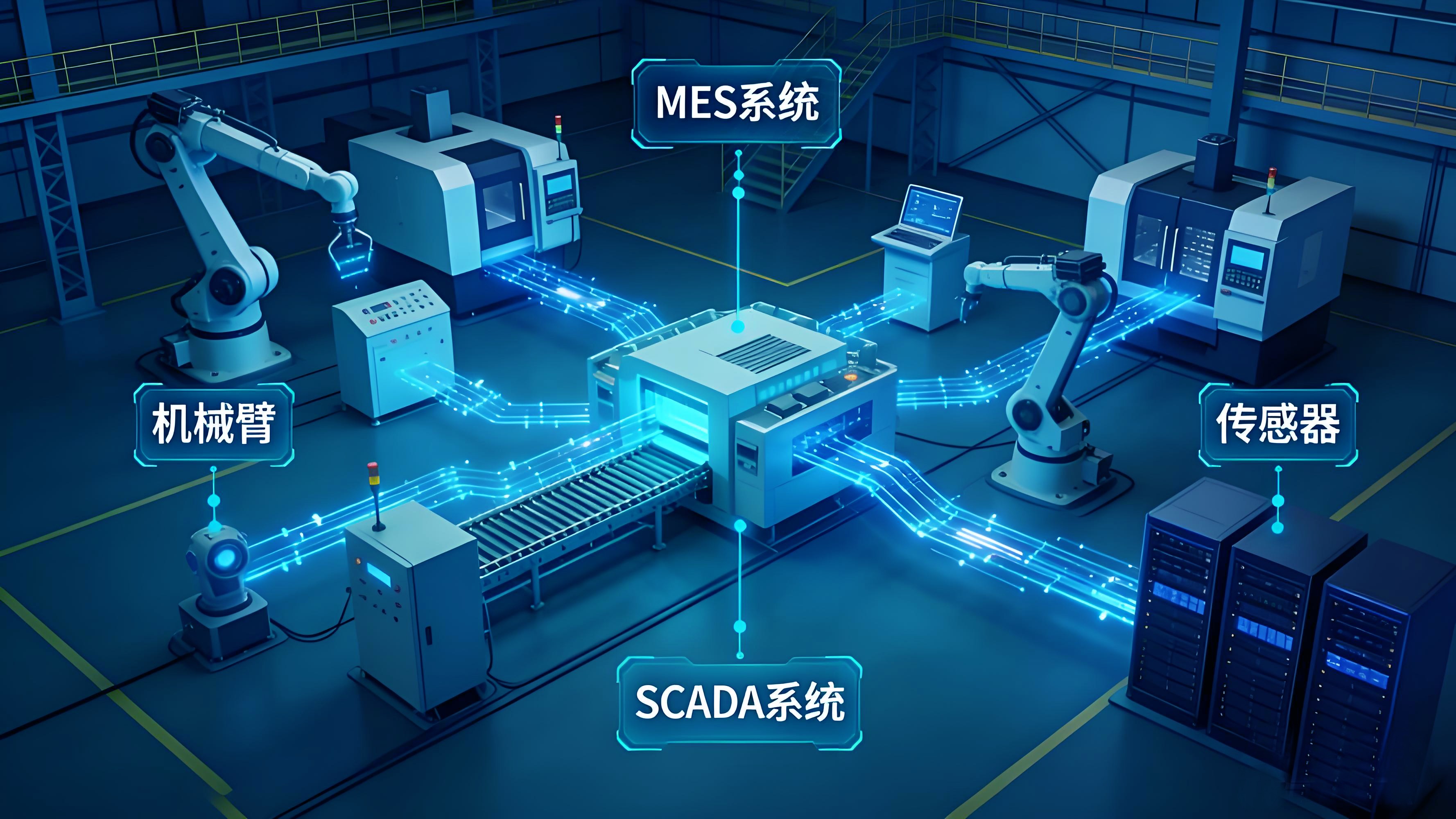
The third long-term trend that cannot be ignored is the "ubiquitous" demand for sensors resulting from the digital transformation. Major economies are accelerating the digital and intelligent transformation of the industrial chain, and the integration of AI and industrial scenarios is moving from pilot projects to large-scale implementation. The concepts of intelligent factories, smart supply chains, and predictive equipment maintenance are grounded on the reliable collection of displacement, speed, and position signals in the physical world. Sensors are no longer just a component in large equipment but are becoming the source nodes of industrial data streams. The real-time position feedback of each moving axis constitutes part of the data foundation. The application fields of Tianxian Digital Intelligence have expanded from new energy, automobiles, and lasers to stone, woodworking, and aluminum window processing. Although they seem scattered, they actually point to the same judgment: displacement measurement is moving from being "exclusive to high-end equipment" to becoming a "standard for the entire industrial field". Whoever can provide a reliable magnetic grating measurement solution at a reasonable cost will be able to occupy the entry position in this round of industrial digitalization wave.
Returning to the mission of Tianxian Digital Intelligence and Magnetic Positive Intelligence - "Helping Chinese Made products enter the global stage". This sentence has a heavier weight in the context of 2026. The ticket to enter the world stage is never obtained by scale. When the global supply chain is reorganized in turmoil and tariffs and regulations become regular tools of negotiation, what truly enables a Chinese enterprise to stand firm is the fact that its products cannot be easily replaced in the customer's BOM list. The domestic substitution of absolute value magnetic encoders is essentially doing one thing: allowing China's high-end equipment manufacturers to move towards global competition without having to look back at others' expressions when it comes to core measurement components.

The global manufacturing landscape is still undergoing intense upheaval. Energy prices, trade rules, technological blockades - every move they make could potentially alter the outcome in a particular area. However, the underlying logic remains stable: in times of greater instability, the precision of self-control becomes increasingly valuable. For a company that has been manufacturing magnetic sensors for fifteen years, this is both an opportunity bestowed by the times and a commitment that requires continuous technological innovation to fulfill.