Products
+


The situation of the battery power industry: Structural differentiation under dual-wheel drive
In the first half of 2026, the most notable feature of the Chinese battery power industry was the formal establishment of the "dual-wheel drive" pattern of power and energy storage. The growth rate of battery power vehicle installations dropped to around 12%, while the shipment volume of energy storage batteries soared by over 80% year-on-year, accounting for 32.5% of the total sales volume and becoming the true growth engine. The production capacity construction of battery manufacturers no longer simply followed the fluctuations in the sales volume of new energy vehicles; energy storage orders provided independent and higher growth demand support.
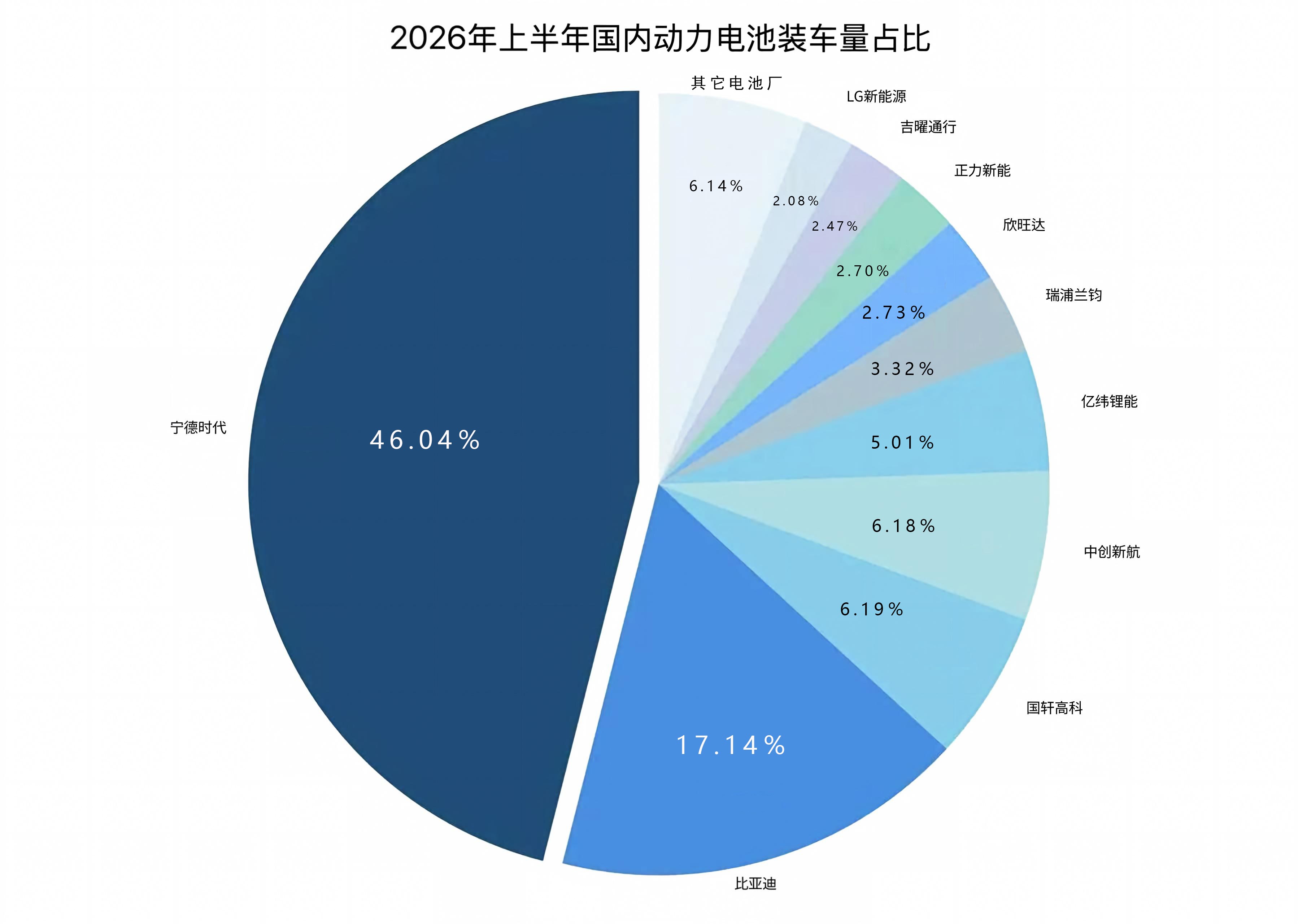
There is a significant differentiation at the enterprise level. In the first half of the year, CATL's domestic vehicle installation volume was 154.3 GWh, with a market share of 46% and a global market share of 40.2%. Its net profit was 43.28 billion yuan, and the capacity utilization rate was 94.86%. The domestic share of its lithium-ion batteries was 75.2%. BYD's vehicle installation volume decreased by 18% year-on-year to 57.4 GWh, mainly due to the slow progress of external supply and the impact of fluctuations in the vehicle sales structure. GES Hi-Tech ranked among the top three in the domestic market for the first time, with an installation volume of 20.75 GWh, but its non-扣除净利润 was only 107 million yuan, with approximately 1.2 billion yuan of profits coming from the fair value changes of financial assets and government subsidies. Sinotianhang's net profit increased by 100% to 1.1 billion yuan, and its global market share for commercial vehicles was once as high as 10.2%. Yilioluangeng's net profit doubled year-on-year, and the shipment growth rate of its energy storage batteries was 54.88%.
The upstream also benefited simultaneously. The average price of lithium carbonate in the second quarter reached 177,000 yuan per ton, and the futures price once exceeded 200,000 yuan per ton in May. Dayi Liangye's parent company's net profit in the first half increased by as much as 3,276% to 493.5% compared to the previous year. Ganfeng Liangye expected a growth of 787% to 966%. Upstream lithium salt enterprises seized most of the price increase benefits, while the increase in the middle and downstream material links was significantly weaker than that of the upstream. Battery enterprises mitigated cost pressure through long-term contracts and scale effects. The imbalance in the distribution of profits in the industry is a typical feature as the industry moves from the explosive phase to the mature phase.
The performance of the capital market shows a significant deviation from the fundamentals. CATL's share price dropped by more than 35% from its peak in May, and the total market value of A+H shares decreased by more than 700 billion yuan. Sinotianhang's Hong Kong stock price halved compared to its 52-week high, with a price-to-book ratio of only 0.79 times. Yilioluangeng reached its 52-week low. At the sector level, the battery sector and battery chemical sector have experienced a range decline of 15.75% and 32.99% respectively since May, while the net profits for the first quarter increased by 49.26% and 378.86% respectively. The root cause of the deviation lies in the fact that three long-term variables have been priced in advance: the withdrawal of vehicle purchase tax incentives raises concerns about domestic demand; the price of lithium carbonate dropped from 200,000 yuan per ton to 145,000 yuan per ton, and the market is worried about overcapacity; the battery consumption tax was implemented in July and will be taxed at a rate of 2% starting from September, gradually increasing, which suppresses profit expectations.

Conduction mechanism: Three paths from the battery production line to the encoder
The first path is the direct equipment demand brought about by the capacity construction boom. In the first half of the year, there were over 65 new planned projects for lithium batteries in China, with a total planned capacity of over 1500 GWh and a total investment of over 220 billion yuan. The 25GWh project of Zhongxin Innovation in Hefei was put into production in September, and the 15GWh project of Fudi of Auto in Changchun was fully mass-produced. GGII predicts that the market size of power lithium battery equipment in China will grow to 33 billion yuan in 2026, with a year-on-year growth of approximately 69%, and the order growth rate of equipment manufacturers is expected to be 20% to 30%. As a key component for achieving precise displacement feedback in lithium battery equipment, the absolute value magnetic encoder has opened up an output window. The displacement control accuracy of absolute value magnetic encoders in processes such as coating, rolling, cutting, winding/folding, etc., directly determines the consistency and yield of the battery cell. This round of equipment delivery cycle will directly translate into an increase in orders for the encoder industry.
The second path is the systematic increase in the requirements for sensor accuracy and reliability due to technological upgrades. The battery power industry is moving from "scale expansion 1.0" to "quality leap 2.0", and the requirements for detection accuracy in directions such as high-energy lithium batteries and solid-state batteries will only be stricter. The absolute value magnetic encoder has the characteristics of retaining the memory position even when power is off and not requiring zero return, and has obvious advantages in processes such as coating, rolling, cutting, winding/folding, etc., where high precision positioning is required and rapid recovery after shutdown. Electromagnetic induction sensors and Hall sensors can cover scenarios such as vibration monitoring and motor speed feedback. The pursuit of quality and efficiency by battery manufacturers will be transmitted along the equipment manufacturer - component manufacturer chain, and sensors with the ability to improve production line rhythm and stability will be given priority for procurement. This conduction is not a linear increase in demand, but a screening of suppliers' technical capabilities.
The third path is the accelerated opening of the domestic substitution window period. The market for high-end absolute value magnetic encoders has long been dominated by Japanese and German brands. Japanese enterprises control over 38% of global shipments, and German enterprises occupy approximately 64% of the share in safety-type encoders. Chinese equipment manufacturers face threefold pressures of high prices, long delivery times, and slow service response. The uniqueness of the battery power industry lies in its extreme sensitivity to cost and strong demands for supply chain security. This combination of "cost sensitivity + security anxiety" has created an unprecedented entry opportunity for domestic magnetic encoders. Domestic enterprises have achieved the accumulation of domestic substitution of imported absolute value magnetic encoders, confirming that this field is shifting from "can it be done" to "can it be delivered on a large scale".
The non-uniformity of the transmission effect
The transmission effect does not uniformly benefit all magnetic scale encoder enterprises; instead, it shows significant non-uniformity along several dimensions.
From the perspective of product structure, the degree of benefit for absolute-value magnetic scale encoders is significantly higher than that for incremental products. The requirements for precision, power-off recovery efficiency, and long-term stability in lithium battery equipment determine that the ceiling for incremental encoders in this scenario is limited. The irreplaceability of absolute-value products in key processes such as coating and winding makes them the core beneficiary category in this round of demand upgrade.
From the customer structure perspective, the gap between enterprises that have entered the supply chain of leading lithium battery equipment manufacturers and those still lingering outside the system will be magnified. The lithium battery equipment industry is itself concentrating towards the top, and the order concentration of manufacturers such as先导智能, 利元亨, and 赢合科技 is continuously increasing. Whether a company can enter the qualified supplier list of these equipment manufacturers determines whether it can truly enjoy the benefits of this round of equipment delivery cycle.
From the technical capability perspective, enterprises with system-level delivery capabilities are closing the gap with single-point product suppliers. The magnetic linear encoder industry is undergoing a transition from "component value" to "system value", and the customer procurement logic has shifted from "whether it can measure" to "whether it can stably support the overall machine's rhythm, reduce downtime, and reduce maintenance burden". Domestic magnetic scale encoders have already had the ability to replace in general industrial scenarios, but in high-end lithium battery equipment, semiconductor equipment, and other fields with higher requirements for extreme precision and reliability, the gap with international leading brands still exists. This gap is not a gap in single technical indicators, but a gap in system-level verification and long-term operating condition data accumulation.
From the capital market transmission perspective, the valuation contraction of the battery power sector may indirectly affect the financing environment of the encoder industry. If the capital market financing function continues to weaken, the expansion plans of second-tier battery factories may be postponed or reduced, which will then affect the equipment procurement rhythm and ultimately transmit to the encoder demand.
Risks and Constraints
The uncertainty of the downstream expansion pace is the most direct risk. The growth rate of battery cell shipments has dropped to around 12%. If second-tier battery manufacturers slow down their expansion due to profit pressure, equipment orders may concentrate among the leading players, intensifying supply chain competition. Guoxuan Gaoke's non-GAAP net profit of only 107 million yuan indicates the sustainability of the expansion plans of second-tier manufacturers, which is a warning signal.
The transmission of price wars to the component end is another realistic pressure. Battery manufacturers' gross margins are generally under pressure, and the cost reduction pressure will be transmitted upstream along the supply chain to equipment suppliers, and then to encoder suppliers. If lithium battery equipment manufacturers accept price cuts to secure orders, encoder products may face annual price reduction pressure, and they need to use technical barriers and the irreplaceability of domestic substitution to hedge against this. The effectiveness of this hedging depends on how high the switching cost of domestic magnetic grating encoders is for equipment manufacturers.
Switching of technical routes is a longer-term challenge. The industrialization of new technologies such as solid-state batteries may change the equipment form of some processes. If the new process changes the fundamental requirements for displacement measurement, there is a long-term risk of product substitution. Hall effect sensors still occupy 47.35% of the magnetic sensor market, but TMR (tunnel magnetoresistance) technology is expanding at a compound growth rate of 8.46%. The industry needs to answer whether it can form effective productization capabilities on multiple technical routes such as Hall, AMR (anisotropic magnetoresistance), and TMR, rather than making a single breakthrough at a certain technical node.
Shortcomings in supply-side capabilities also constitute constraints. The substitution ability of domestic magnetic grating encoders in general industrial scenarios is already mature, but in system-level verification and long-term operating condition data accumulation in high-end scenarios, it is still insufficient. If the industry as a whole is unable to form a qualified supply capacity of scale in the lithium battery equipment supplier's supply chain system for a long time, the window period may be closed by the price-cutting strategies of overseas brands or the self-research plans of equipment suppliers.
Overall assessment
The transmission effect of the battery power industry on the magnetic scale encoder industry in China is clear in the short term: an increase in equipment demand. In the medium term, it brings about an increase in product value due to precision upgrades and accelerates the window for domestic substitution. In the long term, it depends on the realization of overseas expansion and equipment domestication. The continuous pressure on the capital market, the deterioration of the profits of second-tier manufacturers, and the transmission of price wars all indicate that this transmission is not a universal industry dividend, but a structural opportunity that concentrates on suppliers with technological barriers and system-level delivery capabilities.
From a broader perspective, the domesticization process of the magnetic scale encoder industry occurs simultaneously with the overall reconfiguration of China's high-end manufacturing supply chain. Germany's import of high-end industrial products from China exceeded its exports to China for the first time. China began to export chips, precision machinery, and robotic arms, which are supporting products for global manufacturing, to the world. As the "eyes" and "perception nerve" of industrial equipment, the domesticization level of magnetic scale encoders directly relates to whether China's high-end equipment can truly match international standards in terms of precision and reliability. The demand pull from the battery power industry is one specific scenario in this larger process - if the magnetic scale encoder industry can prove itself in the lithium battery equipment scenario, which is sensitive to cost, anxious about safety, and has continuously upgraded precision requirements, this ability can be transferred to high-value scenarios such as machine tools, semiconductors, and robots. The window has opened, but the window period will never wait.