Products
+


While the world's attention is still focused on the Middle East, the waves in the Strait of Hormuz are not only affecting oil prices, but also the already strained nerves of the global manufacturing industry. For every dollar increase in crude oil prices and every day delay in freight transportation, there is an additional silent pressure in the noisy factory workshops along China's coast. The costs passed down from the upstream sector flow like water overflowing a dam, gradually seeping into every purchase order and every delivery commitment. The more sophisticated the equipment, the higher the requirement for the stability of the supply chain. And deep within those high-speed rotating motors and reciprocating motion modules lies a link that was rarely discussed in the past, but which, once in short supply, could cause the entire production line to come to a halt - the displacement sensor.
We seldom perceive its existence in our daily lives, yet it is omnipresent. When a CNC machine processes an aviation rotor, it relies on it to confirm the feed of each cut; when industrial robots repeatedly pick up items on the assembly line, it ensures the repetitive positioning accuracy of each action; when semiconductor equipment etches circuits on wafers, it controls the position error within micrometer levels. Linear motor modules, lead screw modules, laser cutting heads, lithium battery winding machines - for almost every precise motion scenario you can imagine, there is an invisible "eye" constantly outputting position coordinates. Without this eye, the equipment would have no idea where it is or where it should go.
And this crucial link that affects the overall situation has, for a long time, had almost no bargaining power for domestic high-end equipment manufacturers. Japan's encoders and Germany's grating rulers monopolize all technical paths from chips to algorithms. If you want to buy, you have to accept their pricing, their delivery schedules, their payment terms, and even their potentially changing supply strategies at any time. A more realistic problem is that, once international circumstances change, trade policies tighten, or there is any fluctuation in upstream production capacity, the first ones affected will always be domestic users. The waiting period can range from several weeks to several months, while the production line cannot stop and delivery cannot be delayed. The pressure ultimately falls entirely on the manufacturing enterprises themselves.
It was precisely in such a narrow gap that a Shenzhen-based enterprise founded in 2011 - Tianxian Digital Intelligence - turned its attention to this territory that had long been dominated by foreign capital, and decided to start from the very bottom.
From 2011 to today, it has been exactly 15 years. If measured in "years", this is just a number. But if measured in "precision", these 15 years are the cumulative result of countless zeros and zeros and one millimeter. Tianxian Digital Intelligence and its wholly-owned subsidiary Magzhen Intelligent have not changed their course or avoided detours in these 15 years. They have always been deeply engaged in the field of magnetic sensors. From material selection to chip design, from algorithm architecture to complete machine testing, they have gradually transformed the absolute value magnetic encoder that could only rely on imports into a cornerstone of the domestic supply chain.
This process is more solitary than imagined. The core technology of the absolute value encoder spans materials science, electromagnetism, signal processing and precision manufacturing. In the past, the most crucial chips and algorithms were long held by a few international giants, with strict patent barriers. To bypass them, one could only forge ahead. Tianxian Digital Intelligence and its wholly-owned subsidiary Magzhen Intelligent chose the path of self-developing FPGA hardware acceleration algorithms, starting from the bottom-level chip architecture, without relying on imported solutions or applying ready-made templates. They used a completely autonomous technical system to achieve high-speed and high-precision real-time position calculation. This path was slow, but each step was solid.
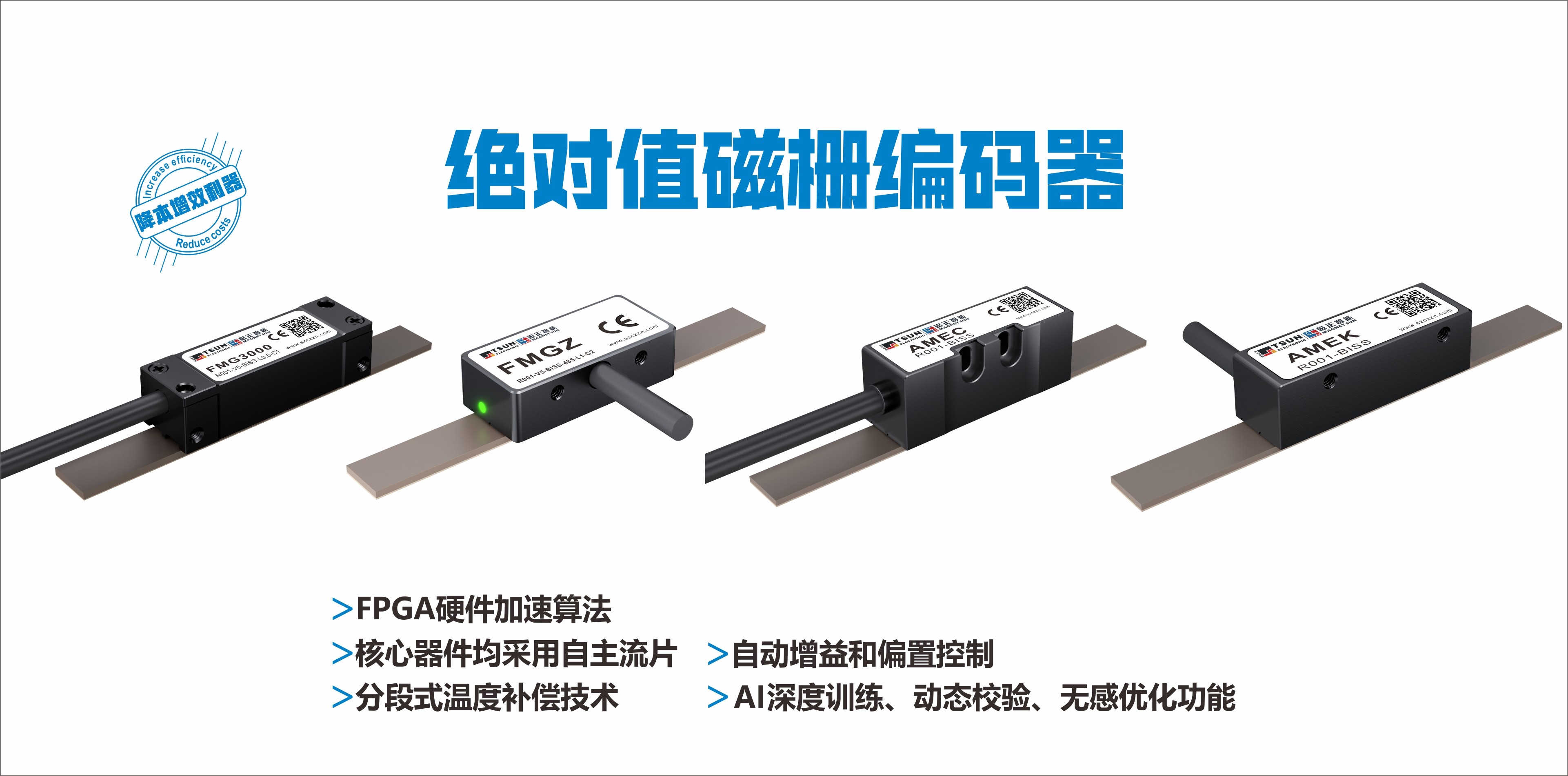
When the FMG series absolute value magnetic encoder was finally launched to the market, it brought not just a product, but a fundamental change in the underlying logic. Its core competitiveness lies not in the casing or the interface, but in a set of intelligent algorithm systems deeply integrated with FPGA hardware acceleration, segmented temperature compensation, AI dynamic verification and power-off memory functions. These technical terms may sound a bit stiff, but their transformation effects in the industrial field are very direct.
FPGA hardware acceleration compresses the delay from signal acquisition to output to the microsecond level, thereby enabling the high-speed linear motor module to achieve more precise trajectory tracking, improving the processing surface quality of precision machine tools, and making the movements of industrial robots smoother and more fluid. Segmented temperature compensation responds to a problem encountered almost every day in industrial sites - temperature drift. During the startup of a cold machine and the operation of a hot machine, mechanical structures undergo subtle changes, which are difficult to detect on a macro level but sufficient to cause data deviations. The FMG series automatically corrects deviations within a wide temperature range of minus ten degrees to seventy degrees using a built-in temperature sensing network and segmented compensation algorithms. The output remains consistent in cold winter workshops in the north and hot production lines in the south.
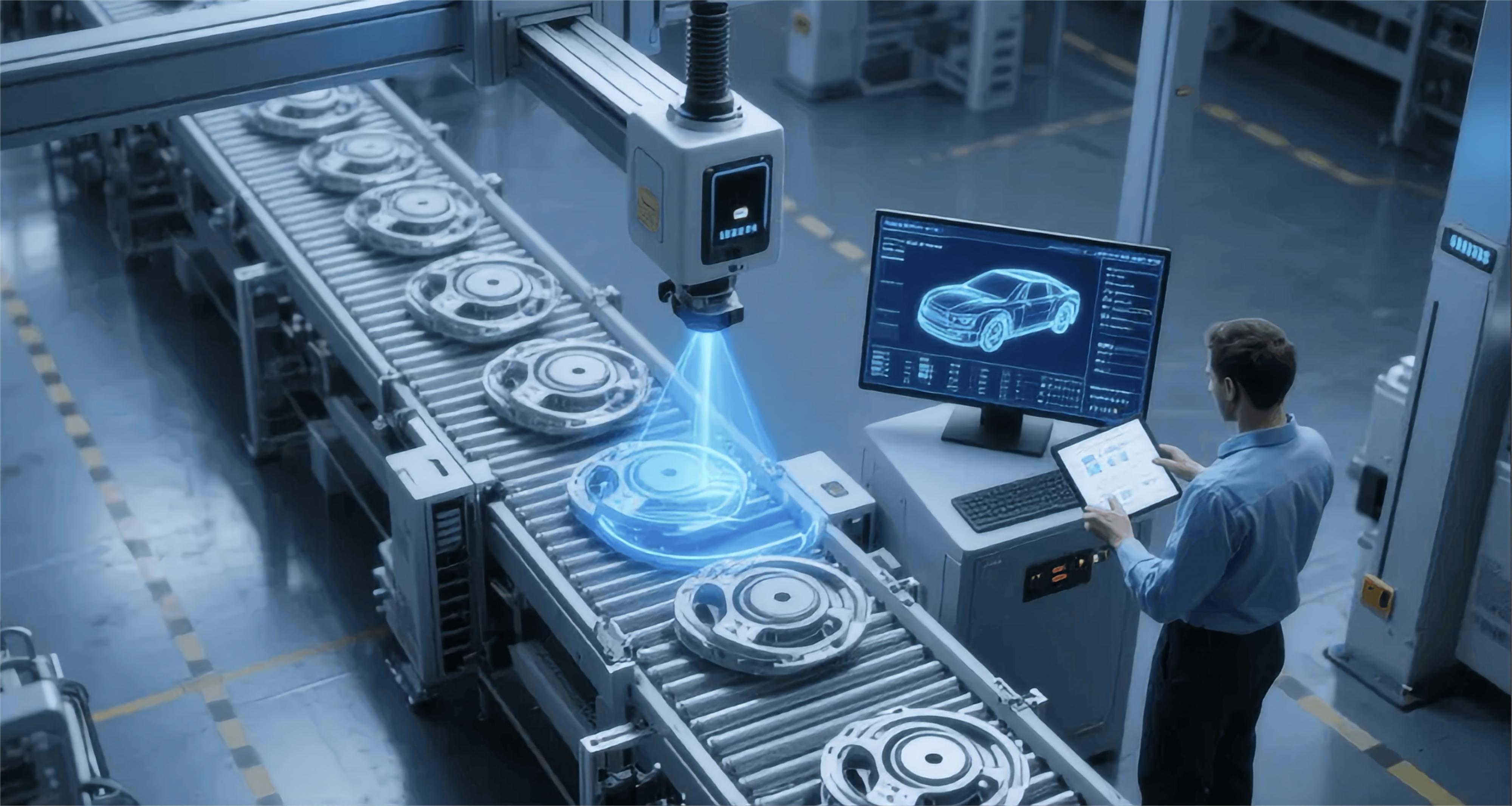
The more notable changes come from the AI dynamic verification function. The encoder continuously collects operating condition data during the equipment's operation. Through the built-in model, it analyzes the signal quality in real time and automatically identifies and compensates for errors caused by mechanical wear, installation deviations, vibration interference, etc. The entire optimization process is completed seamlessly in the background without interfering with the production rhythm. However, the stability and accuracy of the equipment continuously improve during its service life. This is an encoder that learns, moving from passive measurement to active calibration, using algorithms to make the hardware run more stably.
The power-off memory function addresses a seemingly insignificant but frequently causing production halt problem. In the event of a sudden power outage, the equipment needs to re-zero and re-verify the position before resuming power. This is time-consuming and labor-intensive. The FMG series can immediately restore the absolute position information before the power outage and be ready for use upon power-on, compressing the downtime to the shortest. For a high-speed production line with an output of thousands of pieces per hour, every minute saved is real output.
The combination of these technical features ultimately results in an extremely simple outcome - stable and reliable, with strong adaptability. The FMG series maintains consistent performance in dirty machine tool workshops, vibrating stamping lines, and complex electromagnetic interference laser equipment. Currently, it has been widely applied in numerous fields such as new energy equipment, automotive manufacturing, industrial robots, semiconductor equipment, machine tool equipment, multi-motor variable torque motors, laser processing, linear motors and screw drive modules, and is proving the same thing in every scenario: domestic encoders can not only replace imported ones but also perform better.
In the past, the story of Chinese manufacturing was often told in terms of scale and speed. But today, the core of the story is changing. From scale to precision, from assembly to core components, from reliance on imports to self-control - this transformation occurs in every niche field, every technological breakthrough, and every redefined sensor.
In 2011, no one could have predicted that a start-up in Shenzhen would have achieved such a great success in the field of magnetic sensors. 15 years later, when the products of Dayishizhi and Magzhiang Intelligent were recognized by an increasing number of domestic equipment manufacturers and adopted by an increasing number of key production lines, it was no longer just the growth story of a single enterprise; it was a microcosm of China's manufacturing industry's breakthrough in core components.
Although the scale is small, it measures the confidence of a major industrial country. We have been on this path for 15 years and will continue to do so.